Showing posts with label #blogjune. Show all posts
Tuesday, June 02, 2020
#blogjune 2020 Crochet
A few years go I taught myself how to crochet. It is a slippery slope for a craft oriented person because of all the stash one can acquire. I have finished a beanie. And started a hooded cowl.
Monday, June 01, 2020
#blogjune 2020 Kayak completed
Last post for #blogjune 2019 was about the kayak. It's finally completed and has had a maiden voyage. In fact, it's been on the water about 3 times now. The #nzlockdown meant we didn't have the planned holiday up north where it was going to be used extensively. But once winter is over here, hopefully we'll be able to re-visit those plans. In the meantime, the odd weekend paddle will have to suffice.
DH has another identical kayak cut out and will be making another two seater, making family outing with all parties possible.
The kayak has yet to be named - it will have a sea bird name of some kind.
Wednesday, June 05, 2019
#blogjune Loved titles
Inevitably I bring you a post about books.
I am not a particularly “literary” librarian. I read what I like to read which varies according to my interests and mood. You can find me on Goodreads (in the sidebar) if you want to see what I’m reading. I'm exploring a lot more titles from non-white, European backgrounds these days in an attempt to decolonise what I read.
Here are some of my favourite titles from childhood reading.
Like other bloggers doing #blogjune, Tintin and Asterix were constantly read too. In fact, some of the family vocabulary and sayings stem from these. For example, "could be, could be not, couldn't rightly say" from one of the Asterix books.
Judy Blume was another author I read frequently in my teen years.
Ultimately, I reached the age when I ventured into the Adult section of the library. My parents never censored what I read and apart from a brief prudish episode in my 15th year when I tried to avoid sexy bits in books, I ranged far and wide through many authors. Leon Uris and James Mitchener were some I remember exploring. I read Samuel Pepys entire diary from start to finish. I read voraciously, often staying up late after everyone else at turned out the lights, to finish books. I suspect I don't read quite as much as I used to, and these days a very rarely re-read books. I'm also a lot fussier and will abandon something if it isn't grabbing my attention.
Tell me your childhood favourites!
I am not a particularly “literary” librarian. I read what I like to read which varies according to my interests and mood. You can find me on Goodreads (in the sidebar) if you want to see what I’m reading. I'm exploring a lot more titles from non-white, European backgrounds these days in an attempt to decolonise what I read.
Here are some of my favourite titles from childhood reading.
I don’t recall when I started reading this series (and the Emily series too) but I re-read them over and over for quite a while.
Similar in style to Anne of Green Gables.
I loved this series and must have revisited them a bazillion times. I still love them and the illustrations by Garth Williams.
This mystery series along with The Three Investigators were constant reads for me. I have a life long love of mystery, crime and thrillers.
Blyton, (although much maligned by many) was staple fare. The Famous five, Magic Far Away tree, the Children of Cherry Tree Farm. Not the Secret Seven though, I thought they were a bit tame.
This was another series I liked. I enjoyed books about animals and vets. James Herriot, Joy Adamson and Gerald Durrell were devoured once I was old enough.
Like other bloggers doing #blogjune, Tintin and Asterix were constantly read too. In fact, some of the family vocabulary and sayings stem from these. For example, "could be, could be not, couldn't rightly say" from one of the Asterix books.
Judy Blume was another author I read frequently in my teen years.
Ultimately, I reached the age when I ventured into the Adult section of the library. My parents never censored what I read and apart from a brief prudish episode in my 15th year when I tried to avoid sexy bits in books, I ranged far and wide through many authors. Leon Uris and James Mitchener were some I remember exploring. I read Samuel Pepys entire diary from start to finish. I read voraciously, often staying up late after everyone else at turned out the lights, to finish books. I suspect I don't read quite as much as I used to, and these days a very rarely re-read books. I'm also a lot fussier and will abandon something if it isn't grabbing my attention.
Tell me your childhood favourites!
Sunday, June 02, 2019
#blogjune Loved places
Maungakiekie/ One Tree Hill is one the 60+ volcanoes that make up Tāmaki Makaurau/Auckland's landscape.

In pre-European times it was the largest Māori pā in the region. It has seen long periods of occupation, fighting and cultivation for the rich, volcanic soil is highly fertile and proved excellent for growing crops. Just as the soil is highly fertile, so is the history rich in tales. Those aren't my stories to tell in this blog, but you can read them elsewhere.
The surrounding land became a public park in 1901 (more or less) through a circuitous route. This is the park I've known and the threads of my life have been interwoven with it at a number of points along the way.
As a child, I could see the top of the cone from my bedroom window at least until the neighbor's oak tree grew too high. We regularly drove by the gates in our maroon Cortina and then the sunshine yellow Datsun Sunny on the way to Sunday morning fellowship. Squeezed in the back with my sisters, we'd frequently clamour for a visit on the way home. At that time, our greatest interest was the playground which contained three important features.
Firstly, a mono-rail train that we sat in while some hapless adult pushed us around the rail circle, through a damp, mouldy smelling tunnel and out the other side to a "station". Given the effort required to propel this, the adult quickly tired of it and we'd be encouraged to move on to something less taxing.
The second point of interest was the slide. Painted an optimistic winter sky blue, this slide wound it's way around an oak tree and emerged at it's roots onto a rubbery type mat. The original planter of the oak probably didn't intend these venerable trees to be forced into such frivolous activity, but this wasn't one of the boring, safe slides you have today. This slide was actually a worthwhile ride.
Lastly, this park had a genuinely exciting flying fox on which you breathlessly swooped down to a hard braking bump, the momentum forcing you to swing joyously out over the path and back again. It is a bit tamer now.
A trip to the park often ended at Ollies, the ice cream parlour in nearby Royal Oak. Ollies seemed to have every possible flavour of ice cream including some exotic ones that adults liked and we did not, such as Rum and Raisin or Cassata. We would roll the wooden slider door back and press up to the counter, searching the menu board while breathing in the heady, humid mix of milky ice cream and cloying hot oil for the fry ups. Having obtained the cone of choice, we would seat ourselves at a sticky table, surrounded by the beeep boop beep of the spacey machines and continuous woosh from the cars outside driving around the round-about.
We often took overseas visitors to the park. From the top of the cone there is a 360 degree view of the Auckland isthmus showing both harbours. It was a picnic park of choice for family and church gatherings.

Fish-eye view from the top of One Tree Hill by Beth Wilson on Flickr
https://www.flickr.com/photos/mirsasha/40960237115
In the late 90's, it became the place of courtship for my husband and I. I would drive there in my rusty blue Mazda hatchback and meet him in one of the car parks. From there we would walk, earnestly talking about our hopes and dreams, forging connections and exploring if we wanted to spend our lives together. It was here he first grabbed my hand, startling me, as we walked along, a thing that became natural as the day wore on.

View from One Tree Hill, Auckland by Traveltt on Flickr
https://flic.kr/p/8knhde
The park was a place to escape the interested eyes of younger sisters and parents while we exchanged heated kisses and increasingly passionate explorations. On Waitangi Day 1999 we strolled along one of the lava spurs overlooking a crater where some teens were sliding down the slopes on old carboard boxes. He turned to me as I was avoiding clumps of olive green sheep poo and asked me, a little hesitantly, to marry him. Reader, I said yes. Six months later we celebrated our marriage elsewhere in the same park at a function centre.
It has been 20 years now. I have taken the children to the park a few times since.
Now we live 33 kms away so it is not as easy to get to. Tāmaki Makaurau - the place of many lovers, or perhaps the place of many loves. Certainly Cornwall Park is a loved place for me.
In pre-European times it was the largest Māori pā in the region. It has seen long periods of occupation, fighting and cultivation for the rich, volcanic soil is highly fertile and proved excellent for growing crops. Just as the soil is highly fertile, so is the history rich in tales. Those aren't my stories to tell in this blog, but you can read them elsewhere.
The surrounding land became a public park in 1901 (more or less) through a circuitous route. This is the park I've known and the threads of my life have been interwoven with it at a number of points along the way.
As a child, I could see the top of the cone from my bedroom window at least until the neighbor's oak tree grew too high. We regularly drove by the gates in our maroon Cortina and then the sunshine yellow Datsun Sunny on the way to Sunday morning fellowship. Squeezed in the back with my sisters, we'd frequently clamour for a visit on the way home. At that time, our greatest interest was the playground which contained three important features.
Firstly, a mono-rail train that we sat in while some hapless adult pushed us around the rail circle, through a damp, mouldy smelling tunnel and out the other side to a "station". Given the effort required to propel this, the adult quickly tired of it and we'd be encouraged to move on to something less taxing.
The second point of interest was the slide. Painted an optimistic winter sky blue, this slide wound it's way around an oak tree and emerged at it's roots onto a rubbery type mat. The original planter of the oak probably didn't intend these venerable trees to be forced into such frivolous activity, but this wasn't one of the boring, safe slides you have today. This slide was actually a worthwhile ride.
Lastly, this park had a genuinely exciting flying fox on which you breathlessly swooped down to a hard braking bump, the momentum forcing you to swing joyously out over the path and back again. It is a bit tamer now.
A trip to the park often ended at Ollies, the ice cream parlour in nearby Royal Oak. Ollies seemed to have every possible flavour of ice cream including some exotic ones that adults liked and we did not, such as Rum and Raisin or Cassata. We would roll the wooden slider door back and press up to the counter, searching the menu board while breathing in the heady, humid mix of milky ice cream and cloying hot oil for the fry ups. Having obtained the cone of choice, we would seat ourselves at a sticky table, surrounded by the beeep boop beep of the spacey machines and continuous woosh from the cars outside driving around the round-about.
We often took overseas visitors to the park. From the top of the cone there is a 360 degree view of the Auckland isthmus showing both harbours. It was a picnic park of choice for family and church gatherings.

Fish-eye view from the top of One Tree Hill by Beth Wilson on Flickr
https://www.flickr.com/photos/mirsasha/40960237115
In the late 90's, it became the place of courtship for my husband and I. I would drive there in my rusty blue Mazda hatchback and meet him in one of the car parks. From there we would walk, earnestly talking about our hopes and dreams, forging connections and exploring if we wanted to spend our lives together. It was here he first grabbed my hand, startling me, as we walked along, a thing that became natural as the day wore on.

View from One Tree Hill, Auckland by Traveltt on Flickr
https://flic.kr/p/8knhde
The park was a place to escape the interested eyes of younger sisters and parents while we exchanged heated kisses and increasingly passionate explorations. On Waitangi Day 1999 we strolled along one of the lava spurs overlooking a crater where some teens were sliding down the slopes on old carboard boxes. He turned to me as I was avoiding clumps of olive green sheep poo and asked me, a little hesitantly, to marry him. Reader, I said yes. Six months later we celebrated our marriage elsewhere in the same park at a function centre.
It has been 20 years now. I have taken the children to the park a few times since.
2009 at Cornwall Park
Saturday, June 01, 2019
#blogjune Writing with pencil
Writing with pencil as a satisfying tell. Perhaps it is the tactile or haptic feedback of pressure on paper. Or the swirly, scratchy sound of the lead trailing behind the pencil tip as it travels over the paper landscape. Typing has it's own satisfaction but it is different for me.
A primary school we had to use pencil until we could write sufficiently well to graduate to pen. Those early letters, painstakingly traced in the double spaced books we had, were like explorers venturing into an unknown terrain. For some, there were monsters waiting, especially if you deviated from the "correct" formation or held your pencil "wrong". Not so for me. I still have a callous on my right middle finger even though most writing I do now is via a keyboard.
5x HB pencils were listed on the stationery list. Back in the 70's when I started school there were only a few options for pencil brands. Red and black Staedtler were the most common, I think. You weren't to use any other grade pencil except HB. Most classrooms had a table mounted sharpener that curled out long shavings, releasing the fresh smell of wood and the somehow grey smell of graphite. Children got told off for staying too long sharpening their pencils. Once a classmate proffered the top of her pencil to everyone sitting at our table. "Here," she said slyly, "Smell this." I knew the smell, even as the other children wrinkled their noses and pretended not to. My suspicions were confirmed when I watched her sneak it under the table and inside the edge of her Womble undies to re-anoint it with odour.
Pencils had to be named of course. Gently Dad would scrap off a little bit of paint at one end leaving the wood bare for my name to be printed carefully on it. The name would sometimes be destroyed by teeth marks as many pencils suffered the indignity of having their tops chewed. But oh, the sensation of breaking through the initial resistance of the paint to the softer wood below was irresistible to young teeth.
Ultimately we moved on to ball point pens. Bic was the most common brand for school pens. How gratifying to see 2x Blue Ball Point Pens on your stationery list? No more "baby" pencils for you in Standard 3. Even so, sometimes you would write in pencil before tracing over with pen. Usually for title pages on which we spend large amounts of time ornamenting with fancy lettering, colour and pictures until it was almost overwhelmed. The popularity of lettering books grew exponentially among us of this age group. Mine was one of the common titles of the day. One offering in the book was a cursive font that I admired mostly because Dad commented favourably that it looked like my grandmother's writing. He had been taught by Nanny to write growing up on a farm and attending the Australian School of the Air. Now an adult, he wrote weekly to Nanny and Poppy who lived still in Australia, and each week there was a letter back in Nanny's elegant cursive. I made it my mission to write like Nanny and at least until I went to University, my writing was pretty good with swoops and dives of copperplate cursive.
I have always loved stationery, so imagine my thrill when obliged to use fountain pens for writing while attending the Ernst Ludwig Schule in Bad Nauheim, Germany during Dad's sabbatical there in 1985-6. There was a much greater choice in pen style than boring Bic, even in the austerity of the 80's. Plastic capsules of ink removed the challenge of bottles and suckers for school children. We even had an eraser pen to dissolve mistakes like magic.
I don't write in in pencil much now. I once used it to scribe notes from an interview but was told it wasn't clear enough for recording purposes so had to go back to pen. Writing with pencil has a sense of impermanence. It is easily erased and we use the phrase "pencil it in" when we're not sure about committing to an event or meeting. Maybe it is the sense of transience or potential that adds to the attraction. But for me, I mostly like how it feels, sounds and the memories it invokes of school classrooms baking in the afternoon sun while we practice our capital A's.
A primary school we had to use pencil until we could write sufficiently well to graduate to pen. Those early letters, painstakingly traced in the double spaced books we had, were like explorers venturing into an unknown terrain. For some, there were monsters waiting, especially if you deviated from the "correct" formation or held your pencil "wrong". Not so for me. I still have a callous on my right middle finger even though most writing I do now is via a keyboard.
5x HB pencils were listed on the stationery list. Back in the 70's when I started school there were only a few options for pencil brands. Red and black Staedtler were the most common, I think. You weren't to use any other grade pencil except HB. Most classrooms had a table mounted sharpener that curled out long shavings, releasing the fresh smell of wood and the somehow grey smell of graphite. Children got told off for staying too long sharpening their pencils. Once a classmate proffered the top of her pencil to everyone sitting at our table. "Here," she said slyly, "Smell this." I knew the smell, even as the other children wrinkled their noses and pretended not to. My suspicions were confirmed when I watched her sneak it under the table and inside the edge of her Womble undies to re-anoint it with odour.
Pencils had to be named of course. Gently Dad would scrap off a little bit of paint at one end leaving the wood bare for my name to be printed carefully on it. The name would sometimes be destroyed by teeth marks as many pencils suffered the indignity of having their tops chewed. But oh, the sensation of breaking through the initial resistance of the paint to the softer wood below was irresistible to young teeth.
Ultimately we moved on to ball point pens. Bic was the most common brand for school pens. How gratifying to see 2x Blue Ball Point Pens on your stationery list? No more "baby" pencils for you in Standard 3. Even so, sometimes you would write in pencil before tracing over with pen. Usually for title pages on which we spend large amounts of time ornamenting with fancy lettering, colour and pictures until it was almost overwhelmed. The popularity of lettering books grew exponentially among us of this age group. Mine was one of the common titles of the day. One offering in the book was a cursive font that I admired mostly because Dad commented favourably that it looked like my grandmother's writing. He had been taught by Nanny to write growing up on a farm and attending the Australian School of the Air. Now an adult, he wrote weekly to Nanny and Poppy who lived still in Australia, and each week there was a letter back in Nanny's elegant cursive. I made it my mission to write like Nanny and at least until I went to University, my writing was pretty good with swoops and dives of copperplate cursive.
I have always loved stationery, so imagine my thrill when obliged to use fountain pens for writing while attending the Ernst Ludwig Schule in Bad Nauheim, Germany during Dad's sabbatical there in 1985-6. There was a much greater choice in pen style than boring Bic, even in the austerity of the 80's. Plastic capsules of ink removed the challenge of bottles and suckers for school children. We even had an eraser pen to dissolve mistakes like magic.
I don't write in in pencil much now. I once used it to scribe notes from an interview but was told it wasn't clear enough for recording purposes so had to go back to pen. Writing with pencil has a sense of impermanence. It is easily erased and we use the phrase "pencil it in" when we're not sure about committing to an event or meeting. Maybe it is the sense of transience or potential that adds to the attraction. But for me, I mostly like how it feels, sounds and the memories it invokes of school classrooms baking in the afternoon sun while we practice our capital A's.
Sunday, June 30, 2013
#blogjune 2013 Day 30: In which I review the week of My Food Bag
It's the last day of #blogjune so I'm wrapping up with a quick review of the first week experience with My Food Bag.
The week we ate...
Day 1: Fish Sliders with apple slaw
Day 2: Jamaican jerk chicken with coconut rice and mango salsa
Day 3: Steak, chickpea and tomato salad with Harissa yoghurt dressing with garlic bread
Day 4: Jazzed up spaghetti bolognaise
Day 5: Butternut and ricotta canelloni with garden salad
All the recipes were easy to follow and mostly were completed and on the table in 30 minutes - some were a bit longer due to me mucking around doing other things at the same time or they required a bit more fiddling e.g. filling canelloni tubes.
The ingredients were fresh and sufficient quantity for our family. The only time I had leftovers was the spaghetti bolognaise and the chick pea salad.
The favourites this week were the fish sliders and the steak salad.
The meat was good quality and tasty.
Most ingredients supplied were organic or free range.
The ease of not having to think about the questions "what's for dinner" and "what do I need to shop for this week" was a big relief for me. I know that sounds pathetic but what I feed my family and being able to enjoy cooking is something that is significant for me so this option helps lower my stress levels.
Was there anything I didn't like? Not really - the only comment I would make is that the fish (gurnard) is on the Forest and Bird's fish guide "orange zone" but given the paucity of options of fish in the "green zone" there has to be some lee way given.
This is what we're having this week. It all looks pretty good to me, though the pumpkin and kumara offerings will be a challenge for Mr9 who doesn't like those vegetables much. The delivery man came in good time.
Unpacking the bags is quite exciting :-)
The week we ate...
Day 1: Fish Sliders with apple slaw
Day 2: Jamaican jerk chicken with coconut rice and mango salsa
Day 3: Steak, chickpea and tomato salad with Harissa yoghurt dressing with garlic bread
Day 4: Jazzed up spaghetti bolognaise
Day 5: Butternut and ricotta canelloni with garden salad
All the recipes were easy to follow and mostly were completed and on the table in 30 minutes - some were a bit longer due to me mucking around doing other things at the same time or they required a bit more fiddling e.g. filling canelloni tubes.
The ingredients were fresh and sufficient quantity for our family. The only time I had leftovers was the spaghetti bolognaise and the chick pea salad.
The favourites this week were the fish sliders and the steak salad.
The meat was good quality and tasty.
Most ingredients supplied were organic or free range.
The ease of not having to think about the questions "what's for dinner" and "what do I need to shop for this week" was a big relief for me. I know that sounds pathetic but what I feed my family and being able to enjoy cooking is something that is significant for me so this option helps lower my stress levels.
Was there anything I didn't like? Not really - the only comment I would make is that the fish (gurnard) is on the Forest and Bird's fish guide "orange zone" but given the paucity of options of fish in the "green zone" there has to be some lee way given.
This is what we're having this week. It all looks pretty good to me, though the pumpkin and kumara offerings will be a challenge for Mr9 who doesn't like those vegetables much. The delivery man came in good time.
Unpacking the bags is quite exciting :-)
Friday, June 28, 2013
#blogjune 2013 Day 27: In which I muse about cultural identity and teaching
Today, Hazel blogged about culturally responsive facilitation and her visceral reaction to identity, exclusion and responsiveness.
This is a kind of topic which can trigger some critical responses from people so I respect her willingness to put it out there. It's worth visiting these things though, not just for those of us who teach but also from the perspective of library services.
I thought I would explore some of the questions she asks in her post.
Can a person elect to not engage with the way a learning experience is set up? What is the result of this?
My first response to this is yes... and no. If a person has chosen to "attend" a learning event/experience then I think there has to be some give and take when it comes to acceptance of the parameters of that event/experience.
If I choose to do an online course learning about Drupal then I have to accept that
a) the course will be online which results in a particular style of teaching and presentation of material. In this case, the class participation is via forums, something I find awkward, clunky and because it's not where my PLN lives I don't enjoy using it. So in a sense I choose not to engage completely in the learning experience - I just do the minimal I have to do in this space. I'm not unusual in this I might add, it happens frequently with online learning.
b) the course will reflect the cultural origin of those that created it. In this case it will be North American in style and cultural feel. I accept that even though it makes me feel less engaged with the other participants in the course. However, I'm motivated to learn the content so I look past my ambivalence.
The result of this is that I learn the material but I don't particularly get anything more from the course. Does this matter? In this case, probably not but in other circumstances it might be important.
Can you go in with humility if you have a set of values up front - should they be negotiated as part of the process?
Yes, I think you can and yes I think there should be room for negotiation. If learning is a conversation as per the constructivist approach then both parties bring something. The important bit is sharing those values, accepting there are some that can't be negotiated and working together to find the common values. The humility occurs in being open to negotiation.
What do we have to learn about the people that we are going to be working with?
I think it is worth finding out before the event/experience who the audience will likely be and what kind of expectations and values they bring.
With my classes it's usually a mixture of Asian and Pasifika so I have some ideas about what sort of values these students bring to the class. It is good to learn what kind of behaviours are offensive, what sort of values are negotiable and so on.
For example, I understand many of our Asian students struggle with our teaching culture of questioning. This is a value I bring to the class - I want our students to ask questions of me and answer my questions too. Because they have chosen to attend a class here in this culture there is an expectation they will have to respond to this value, it's not really a value that is negotiable, but I also understand it is uncomfortable for them. I have things I do to mitigate this.
Another example, if I'm going to attend an event/experience at a marae I understand there are some values that will be non-negotiable. My behaviour therefore changes to reflect that, even though there are some things that I find ... not so much uncomfortable as "not the way I personally would do things".
It interests me that if we allow ourselves to be open to the values of other cultures it will affect us in ways we may not expect. For example, most conferences I have been to in New Zealand have some sort of pōwhiri at the beginning. The conference I went to in Australia did not and for me this made the conference beginning seem incomplete. Another example, as a result of being open to tikanga I feel uncomfortable about people sitting on tables even though in my New Zealand European culture it's not a "thing".
A suggestion was that it is necessary to bring something to a session
that is 'part' of the people - analogies, images, ways of talking about
things. But, how do you do that in a diverse community. What if the
analogies are meaningless to some of the people in the room? Do you
focus on the majority? Do you try to cover most of the cultural groups?
Do you cover all of them? How? Or, is the main focus the people in the
room with the most influence? People who are from that part of the
world?
Hmmm... tricky. I don't know. I believe there are things that a common to all cultures even if the language or imagery is different. Exploring that in the session can result in a deeper understanding of the topic and each other. Using language like "this is how I explain this thing, does it work for you or do you have an alternative?" could result in a mutual deepening of understanding.
I have been the one person in a classroom in a foreign culture where I didn't know the language and felt excluded, but at the same time I didn't expect to be catered to either (different age, different circumstances). If I had been more mature and if the learning had been more critical to my advancement I would have made a better effort to be engaged. So something has to come from the the people in the room too, it's not just about the facilitator.
I know I'm still learning about this kind of thing and don't have all the answers.
What do you think?
This is a kind of topic which can trigger some critical responses from people so I respect her willingness to put it out there. It's worth visiting these things though, not just for those of us who teach but also from the perspective of library services.
I thought I would explore some of the questions she asks in her post.
| Choosing to engage or not? |
My first response to this is yes... and no. If a person has chosen to "attend" a learning event/experience then I think there has to be some give and take when it comes to acceptance of the parameters of that event/experience.
If I choose to do an online course learning about Drupal then I have to accept that
a) the course will be online which results in a particular style of teaching and presentation of material. In this case, the class participation is via forums, something I find awkward, clunky and because it's not where my PLN lives I don't enjoy using it. So in a sense I choose not to engage completely in the learning experience - I just do the minimal I have to do in this space. I'm not unusual in this I might add, it happens frequently with online learning.
b) the course will reflect the cultural origin of those that created it. In this case it will be North American in style and cultural feel. I accept that even though it makes me feel less engaged with the other participants in the course. However, I'm motivated to learn the content so I look past my ambivalence.
The result of this is that I learn the material but I don't particularly get anything more from the course. Does this matter? In this case, probably not but in other circumstances it might be important.
![]() |
| Caution! I haz values! |
Yes, I think you can and yes I think there should be room for negotiation. If learning is a conversation as per the constructivist approach then both parties bring something. The important bit is sharing those values, accepting there are some that can't be negotiated and working together to find the common values. The humility occurs in being open to negotiation.
![]() |
| What is everyone bringing to the table? |
I think it is worth finding out before the event/experience who the audience will likely be and what kind of expectations and values they bring.
With my classes it's usually a mixture of Asian and Pasifika so I have some ideas about what sort of values these students bring to the class. It is good to learn what kind of behaviours are offensive, what sort of values are negotiable and so on.
For example, I understand many of our Asian students struggle with our teaching culture of questioning. This is a value I bring to the class - I want our students to ask questions of me and answer my questions too. Because they have chosen to attend a class here in this culture there is an expectation they will have to respond to this value, it's not really a value that is negotiable, but I also understand it is uncomfortable for them. I have things I do to mitigate this.
Another example, if I'm going to attend an event/experience at a marae I understand there are some values that will be non-negotiable. My behaviour therefore changes to reflect that, even though there are some things that I find ... not so much uncomfortable as "not the way I personally would do things".
It interests me that if we allow ourselves to be open to the values of other cultures it will affect us in ways we may not expect. For example, most conferences I have been to in New Zealand have some sort of pōwhiri at the beginning. The conference I went to in Australia did not and for me this made the conference beginning seem incomplete. Another example, as a result of being open to tikanga I feel uncomfortable about people sitting on tables even though in my New Zealand European culture it's not a "thing".
![]() |
| Respecting our differences, finding commonalities |
Hmmm... tricky. I don't know. I believe there are things that a common to all cultures even if the language or imagery is different. Exploring that in the session can result in a deeper understanding of the topic and each other. Using language like "this is how I explain this thing, does it work for you or do you have an alternative?" could result in a mutual deepening of understanding.
I have been the one person in a classroom in a foreign culture where I didn't know the language and felt excluded, but at the same time I didn't expect to be catered to either (different age, different circumstances). If I had been more mature and if the learning had been more critical to my advancement I would have made a better effort to be engaged. So something has to come from the the people in the room too, it's not just about the facilitator.
I know I'm still learning about this kind of thing and don't have all the answers.
What do you think?
Tuesday, June 25, 2013
#blogjune 2013 Day 25: In which I reflect on my online course
I'm into week 4 (the last week) of my online course learning some basic Drupal. These are my reflections so far.
Content
Experience
Content
- Drupal seems to be a good tool to use
- There are a lot of different themes to choose from and finding one that suits your site means spending time scrolling through a bunch.
- Having a clear site plan is necessary.
- The course itself is well laid out and works well on Moodle as a delivery platform, with the exception of the forums which I find sterile and asynchronous.
Experience
- I feel like I'm skimming the surface of the topics - in order to get the work done in the week assigned. I tend to jump through the hoops without any deep reflection or investigation on why/why not things work.
- It was good to have some others doing the course IRL with me - as I said, the forums didn't really work for me. I'm used to the immediacy of Twitter I think. It probably doesn't help that the rest of the class participants were asleep when I was awake, plus a day behind us.
- Others in the class have done some amazing stuff which makes me feel meh, but I just don't have the time to commit to digging deeper.
Friday, June 21, 2013
#blogjune 2013 Day 21: Five things Friday
Heeeeey we're on the home stretch!
1. Shifting sands - was relevant to my interests today as I pondered some stuff happening around me. Also this one on disruptive education.
2. I've bitten the bullet and signed up to My Food Bag. You can see what we'll be eating next week.
3. Am engrossed in Game of Thrones series. Have ideas about "epic" video for promoting library services which led to searching Jamendo for dramatic orchestral music as a sound track. You see how my mind works...
4. These wind sculptures are cool. Probably not so suitable for my Wellington friends right now...
and
5. (For the believers and because I needed this today)
1. Shifting sands - was relevant to my interests today as I pondered some stuff happening around me. Also this one on disruptive education.
2. I've bitten the bullet and signed up to My Food Bag. You can see what we'll be eating next week.
3. Am engrossed in Game of Thrones series. Have ideas about "epic" video for promoting library services which led to searching Jamendo for dramatic orchestral music as a sound track. You see how my mind works...
4. These wind sculptures are cool. Probably not so suitable for my Wellington friends right now...
and
5. (For the believers and because I needed this today)
Thursday, June 20, 2013
#blogjune 2013 Day 20: In which I reveal my crochet attempts
So far....

Not as neat and tidy as Tony's! But still quite fun to do. Haven't finished it yet as it's not really square.

Not as neat and tidy as Tony's! But still quite fun to do. Haven't finished it yet as it's not really square.
Tuesday, June 18, 2013
#blogjune 2013 Day 18: In which I get spicey

What is in your spice cupboard?
Some time ago (2007) I published a list of spices I have in mine. Here is the current line up:
Star anise (whole)
Baharat (home made)
ground chillies
ground cardamom
dried marjarom
curry powder
dill seeds
dried sage
juniper berries
asafoetida
gr. black pepper
fenugreek seeds
mixed spice
brown & yellow mustard seeds
belacan
black peppercorns (whole)
caraway seeds
dry mango powder
poppy seeds
chinese 5 spice
tamarind
lemon pepper
cinnamon quills
kalonji seeds (nigella seeds)
smoked paprika (hot & sweet)
ground turmeric
celery seeds
gr. coriander
gr. cayenne
gr. nutmeg
whole nutmeg
gr. cumin
gr. cinnamon
paprika
cumin seeds
prickly ash/Sichuan pepper
dried oregano
dried tarragon
dried galangal
gr. ginger
saffron
dried chillies (birds eye)
gr. Kashmiri chilli
cloves (whole)
mace
vanilla pods
all spice
coriander seeds
panch phoran
sesame seeds
fennel seeds
cardamon (whole)
ras el hanout (home made)
rose water
garlic powder
brown cardamon pods
I frequently use spices in cooking. Some of my favourite ones are the more familiar ones like cinnamon, cloves and nutmeg. I sometimes use them as a medicinal thing too - rather crudely perhaps but studies have shown benefits of a number of spices listed above. For example, fenugreek appears to have a glucose lowering effect, turmeric apparently has anti-cancer properties and so on. (You can do the literature searches yourself). I have used fenugreek as an anthelmintic and turmeric as an anti-viral against the common cold, both properties of which have been reported.
I love the history, mystery and exotic "romance" of spice.
Friday, June 14, 2013
#blogjune 2013 Day 14: Five things Friday
1. Nobody expects the Spanish Inquisition! Look out for ... the comfy chair!
2. Jelly beans and lists... two good things
3. Tart cherry juice from http://www.cherryvite.co.nz/ is my current obsession. The freeze dried cherries are awesome too. I think it may be helping me sleep, or maybe it's placebo but in any case it tastes good. It is supposed to be full of Good Things.
2. Jelly beans and lists... two good things
3. Tart cherry juice from http://www.cherryvite.co.nz/ is my current obsession. The freeze dried cherries are awesome too. I think it may be helping me sleep, or maybe it's placebo but in any case it tastes good. It is supposed to be full of Good Things.
4. What is your preferred potato chip flavour? Mine is salt & vinegar. DH likes plain or those new sour cream and Kaitaia Fire ones.
5. Spent the evening shopping for birthday presents for other people's children. Not sure what it is about October, but it seems like it's a good month for making babies! (As well as Christmas and New Year... We have 4 family birthdays in September).
Wednesday, June 12, 2013
#blogjune 2013 Day 12: In which I bare my insecurities.
The following may indicate my ignorance but I always say, if you don't ask the question you just remain ignorant...
A while back I did a "self-awareness" course which was about becoming self-aware. (As you might imagine).
For me, it is an uncomfortable and confronting thing to realise how my behaviour affects others' perception of myself. One of the things the course looked at was "transactional analysis" and the kinds of states one goes to during interactions. Based on the observations he made of me during the 3 hour course, the facilitator told me I move into the "free child" state a lot.
The questions I find myself asking are these. In an environment where we are exhorted to be creative, innovative and disruptive in our approach to librarianship, what is the role of the free child? What is the role of Adult in this environment?
Yesterday someone tweeted this blog entry:
There is a part of me that wants to justify allowing the creative side of myself to appear in the work environment - this I freely admit. But I do wonder if I'm shooting myself in the foot to let it do so if I wish to be seen as "professional" and having worthy leadership qualities.
On the other hand, I see a real risk of librarians stagnating into starchy, un-interesting creatures with no flexibility if we do not provide a space for playfulness. Or perhaps I'm just equating "professional" as boring... certainly the times I've been accused of being "not very professional" is when I have been expressing humour or playfulness.
This is very deep. I am interested in your opinion.
A while back I did a "self-awareness" course which was about becoming self-aware. (As you might imagine).
For me, it is an uncomfortable and confronting thing to realise how my behaviour affects others' perception of myself. One of the things the course looked at was "transactional analysis" and the kinds of states one goes to during interactions. Based on the observations he made of me during the 3 hour course, the facilitator told me I move into the "free child" state a lot.
"The Natural Child is largely un-self aware and is characterized by the non-speech noises they make (yahoo, whee, etc.). They like playing and are open and vulnerable.I took from his [the facilitator] attitude that this state is not the one to be in if you want to be a leader or considered a rational adult member of staff. In my defence, I would like to add that on that particular day I was emotionally vulnerable owing to a number of things happening both at work and home.
The ... Little Professor is the curious and exploring Child who is always trying out new stuff (often much to their Controlling Parent's annoyance). Together with the Natural Child they make up the Free Child." ~ from Transactional Analysis [my emboldening]
The questions I find myself asking are these. In an environment where we are exhorted to be creative, innovative and disruptive in our approach to librarianship, what is the role of the free child? What is the role of Adult in this environment?
"the Adult in us is the 'grown up' rational person who talks reasonably and assertively, neither trying to control nor reacting aggressively towards others. The Adult is comfortable with themself and is, for many of us, our 'ideal self'." ~ from Transactional AnalysisOr am I reading too much into this? Are these things unrelated? Have I taken it out of context?
Yesterday someone tweeted this blog entry:
"The antidote to consumption is play: physically and mentally. We have stripped many of our institutions of play as we became heavier with the burden of information to pass on. It is inevitable. But play is not what happens at ‘recess’ or ‘lunch’. Play is not mindless, in the same way not all information is mindless. Compelling information coupled with playful experimentation, helps us create meaning and improve processes." - Consumption MentalityWhile coming from a different perspective, the part about play not being a mindless activity but rather helping us build meaning and improve processes intrigued me.
There is a part of me that wants to justify allowing the creative side of myself to appear in the work environment - this I freely admit. But I do wonder if I'm shooting myself in the foot to let it do so if I wish to be seen as "professional" and having worthy leadership qualities.
On the other hand, I see a real risk of librarians stagnating into starchy, un-interesting creatures with no flexibility if we do not provide a space for playfulness. Or perhaps I'm just equating "professional" as boring... certainly the times I've been accused of being "not very professional" is when I have been expressing humour or playfulness.
This is very deep. I am interested in your opinion.
Monday, June 10, 2013
#blogjune 2013 Day 10: in which I reveal my first attempts at crochet
A couple of worm like things that I hope will end up as a kind of dish cloth! I had some difficulty holding the bits but I think I have that sorted now. My mum also showed me I was doing something working with where I was inserting the hook too - something I didn't actually realize I was doing having watched some videos. Is this an instance where face to face teaching is better? Or did I just not choose the best videos? :-)
Sunday, June 09, 2013
#blogjune2013 Day 9: In which I meet some unexpected issues
A few posts back I mentioned Mr9's tentative diagnosis of dyspraxia. Since then we have been trying to move forward with testing and finding ways to help him.
We were hardly a "hard sell" given the geekiness of our family so we agreed and today Mr9 got an iPad2 (wifi only). It will live at school most of the time, locked away in a secure place when not in use. It can come home when he wants to bring it home though.
We have been helped by the SPELD association who gave him a comprehensive test that revealed some strengths and weaknesses. He now has a SPELD tutor who works with him once a week.
A friend has screened him for Irlen and we see a diagnostician this week.
I am still trying to find an OT for him that will help him and hopefully give a definitive diagnosis. The closest one is too busy - too many ACC cases. Another recommended one has yet to get back to me so I fear the same will hold true of her also. I may yet have to find someone myself. As this is one of the key things he needs I am feeling frustrated!
It has not been cheap either and he doesn't qualify for any funding. It worries me that it will be difficult for us to get assistance like reader-writers when his condition is not considered "severe" enough.
One good thing is that the school have been very helpful and co-operative. His teacher has a 2 other students with learning difficulties so she is open to exploring ideas and ways to deal with this. Additionally, she is trying to incorporate some elearning into the class which is a challenge in a small school with limited funding. She approached us about the possibility of purchasing Mr9 an iPad as she has found some of the apps useful in assisting her to teach her students with learning difficulties - the other 2 in her class have them.
Here he is "unboxing" his iPad.
We needed to set an email for him as some of the work he will do on the device will be emailed to his teacher rather than submitted on paper. We assumed a gmail would be fine, but we discovered he is too young for one! We went back and forth about options and in the end we found Yahoo! allows a child account if you set up a "family account" arrangement.
I am just hoping we'll be able to find a similar thing for gmail because I suspect he will need to use some of the Google apps like docs. Perhaps the school has Google for schools? I don't know but will have to find a way to work around this. In the meantime, the Yahoo! address will have to do.
One of the apps I installed for him is the Overdrive one for borrowing library ebooks and audiobooks. Of course, it needs to have an Adobe ID. Mine has been used on too many devices so I had to make one for him as well.
It both amuses and alarms me that Mr9's digital footprint is already growing as a result of this purchase we've made.
Here are my loves heading out to this morning's fellowship. Miss6 is not impressed she didn't get an iPad. Mostly because she wants to play Fruit Ninja.
Saturday, June 08, 2013
#blogjune 2013 Day 8: In which I fall back on a bullet point post
Because I am tired and sad.
In blossom today, then scattered;
Life is so like a delicate flower.
How can one expect the fragrance to last forever?
Admiral Takajiro Onishi
1. Saturday is a day for the kids to have swimming lessons.
2. A friend in Japan died yesterday - she fought cancer for 3 years, 8 months. Far too young to go, she leaves a son and daughter my age. Cancer sucks.
3. Spent some time helping DH chainsaw up a tree for firewood for my sister and ourselves.
4. Went out to Muriwai so DH could take photos of kingfishers and sunsets.
5. Made home made fish and chips.
In memory of Reiko:
Life is so like a delicate flower.
How can one expect the fragrance to last forever?
Admiral Takajiro Onishi
Thursday, June 30, 2011
#blogjune Day 30: In which I did some PD
How does an elearning librarian spend her day? Today, I attended a webinar screened by the media librarian from UoA (University of Auckland) about streaming audio and video files. It was really interesting to see what and how they are doing this. I know there is some angst in the library world about our tendency to have lots of "How We Done It Good" type PD stuff but I have to say this sort of stuff appeals to my practical side. I usually get ideas and inspiration from things like this.
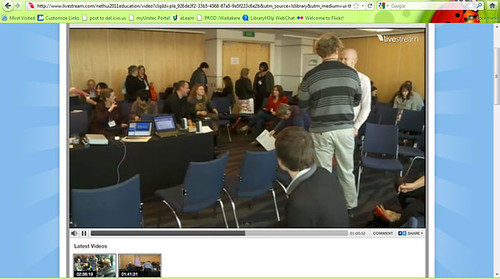
In the afternoon, I attended Nethui and spent most of the time in the Education stream, briefly venturing out to hear about the social media response to the Christchurch quakes. Se if you can spot me in the Livestream video they had running - I'm talking to my former colleague Li.

I was a little disappointed that the focus, or perhaps more correctly, the participant dominance in the Education stream was from primary and secondary levels. I was not disappointed that they were present - I think it is great - but the disappointment lay in the lack of tertiary level education participants. I think the only tertiary level people there were librarians. Still - there were interesting discussions, and of course, much overlap in terms of issues at every level of education. E.g. Infrastructure, resistance from overwhelmed teachers to eLearning, need to focus on the learning not the tools and so on. It's hard to know where to start but I think the answer does lie in the carrot & stick model, plus opportunities to hear from others about success stories.
One thing that is so necessary is the perceived freedom to "play" and to have risk friendly environments in which that "play" can occur. This isn't easy - in the tertiary sector one is so conscious that students have paid large sums of money to be there and "playing" with a new approach can seem irresponsible. Yet, I've witnessed some great exemplars at MPOW where technology and social eLearning has been very effective in courses that you would think it would fail - such as construction and automotive classes.
This was hardly a normal day in the life for me, but it was a nice interlude. And there was Oreo cheesecake.
In the afternoon, I attended Nethui and spent most of the time in the Education stream, briefly venturing out to hear about the social media response to the Christchurch quakes. Se if you can spot me in the Livestream video they had running - I'm talking to my former colleague Li.

I was a little disappointed that the focus, or perhaps more correctly, the participant dominance in the Education stream was from primary and secondary levels. I was not disappointed that they were present - I think it is great - but the disappointment lay in the lack of tertiary level education participants. I think the only tertiary level people there were librarians. Still - there were interesting discussions, and of course, much overlap in terms of issues at every level of education. E.g. Infrastructure, resistance from overwhelmed teachers to eLearning, need to focus on the learning not the tools and so on. It's hard to know where to start but I think the answer does lie in the carrot & stick model, plus opportunities to hear from others about success stories.
One thing that is so necessary is the perceived freedom to "play" and to have risk friendly environments in which that "play" can occur. This isn't easy - in the tertiary sector one is so conscious that students have paid large sums of money to be there and "playing" with a new approach can seem irresponsible. Yet, I've witnessed some great exemplars at MPOW where technology and social eLearning has been very effective in courses that you would think it would fail - such as construction and automotive classes.
This was hardly a normal day in the life for me, but it was a nice interlude. And there was Oreo cheesecake.
Wednesday, June 29, 2011
#blogjune Day 29: In which I get a delightful parcel
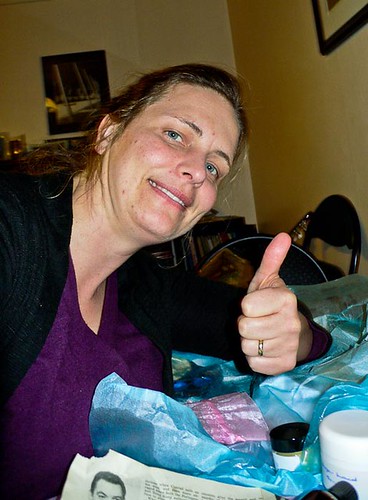
of goodies from Janine! :)

I did have a little giggle at the paper you wrapped the soap in J9 ;-) Looking forward to using them! As soon as I opened the package I could smell the lovely scent - thank you.
Today I didn't get anything done on my paper but I did watch the live stream of Nethui which began today. I had put my name on the waiting list for attendance but didn't hold out much hope of getting a registration, but lo! the library's PA came in to tell me I did and so I'm attending tomorrow afternoon and Friday morning. Looking forward to being there in person. I have to say that Ziln did a great job of live streaming and were responsive to tweets about sound etc from those watching which does them credit.
There was some interesting discussion today and the tweet stream for #nethui is representative of what the sessions were about.
One thing that struck me in the Digital literacy session and the session entitled 21st Century Parenting - Challenges and Solutions, was the focus on Facebook and privacy/safety issues. It would appear that Facebook is held up as an example of what can go wrong in terms of safety online and lack of digital literacy. It bothers me that there are those out there that a) don't bother to dig deep into the settings on their Facebook profile b) let kids younger than 13 use Facebook and c) use ignorance as a cop out to ignore modelling good online behaviour.
Another thing that bothered me from the digital literacy session was the focus of some of the contributors on the basic computing skills such as word processing. I guess I'm more at the information literacy part of the continuum where I feel it is important for people to have discernment when it comes to evaluating where information comes from rather than basic "How To Use Auto Sum In Excel". Clearly, these basic skills are important but I fear for the ability of people to be good digital citizens if all we're teaching them in terms of digital literacy is how to use the functionality of a programme effectively.
Anyway, there was lots of food for thought.

I did have a little giggle at the paper you wrapped the soap in J9 ;-) Looking forward to using them! As soon as I opened the package I could smell the lovely scent - thank you.
Today I didn't get anything done on my paper but I did watch the live stream of Nethui which began today. I had put my name on the waiting list for attendance but didn't hold out much hope of getting a registration, but lo! the library's PA came in to tell me I did and so I'm attending tomorrow afternoon and Friday morning. Looking forward to being there in person. I have to say that Ziln did a great job of live streaming and were responsive to tweets about sound etc from those watching which does them credit.
There was some interesting discussion today and the tweet stream for #nethui is representative of what the sessions were about.
One thing that struck me in the Digital literacy session and the session entitled 21st Century Parenting - Challenges and Solutions, was the focus on Facebook and privacy/safety issues. It would appear that Facebook is held up as an example of what can go wrong in terms of safety online and lack of digital literacy. It bothers me that there are those out there that a) don't bother to dig deep into the settings on their Facebook profile b) let kids younger than 13 use Facebook and c) use ignorance as a cop out to ignore modelling good online behaviour.
Another thing that bothered me from the digital literacy session was the focus of some of the contributors on the basic computing skills such as word processing. I guess I'm more at the information literacy part of the continuum where I feel it is important for people to have discernment when it comes to evaluating where information comes from rather than basic "How To Use Auto Sum In Excel". Clearly, these basic skills are important but I fear for the ability of people to be good digital citizens if all we're teaching them in terms of digital literacy is how to use the functionality of a programme effectively.
Anyway, there was lots of food for thought.
Tuesday, June 28, 2011
#blogjune Day 28: In which I am pleased
I don't really talk about my children's achievements on my blog (since it is of no real interest to anyone but family :-) ), but tonight we had parent-teacher interviews and after last year's fiasco, I have been watching Mr7's progress with some concern. It's hard to know how he is doing for his age group. This year I have been worried about his writing and maths. Anyway, his teacher says that while he has areas on which to work on for these, he (the teacher) is confident he (Mr7) will be up to the right level by the end of the year. His reading has advanced 3 levels from the beginning of the year which is awesome news. He has also risen one maths level too since the year began. He has excellent "topic knowledge" and has strengths in science <-- no big surprises there! I am feeling relieved about things now.
Additionally, I am relieved to have resurrected a family tree file I'd made back in 20004. I'd saved it, but the software used to create the file had gone back to Mum's and we no longer had it There seemed to be no easy way to convert the file to something useful. Fortunately, Mum still had the software running on her machine so DH converted the file to something more universal and we've downloaded some open source family tree software and I can now update it. I wanted to check the tree to see if a connection existed - not sure that it does but hooray for having the data workable again! I'll be backing up the GEDcom file now and also uploading the info to a cloud based genealogy site too (I think) to ensure I've got the data. Some lessons there about digital continuity!
This is Pusscat - he was made for me by my grandma.
Additionally, I am relieved to have resurrected a family tree file I'd made back in 20004. I'd saved it, but the software used to create the file had gone back to Mum's and we no longer had it There seemed to be no easy way to convert the file to something useful. Fortunately, Mum still had the software running on her machine so DH converted the file to something more universal and we've downloaded some open source family tree software and I can now update it. I wanted to check the tree to see if a connection existed - not sure that it does but hooray for having the data workable again! I'll be backing up the GEDcom file now and also uploading the info to a cloud based genealogy site too (I think) to ensure I've got the data. Some lessons there about digital continuity!
This is Pusscat - he was made for me by my grandma.
Monday, June 27, 2011
#blogjune Day 27: In which I make jam drops
which look disturbingly like chicken pox. *wince*
However, they got the stamp of approval from Mr7 who said, "You can put these in my lunch box, Mum."
Subscribe to:
Posts (Atom)